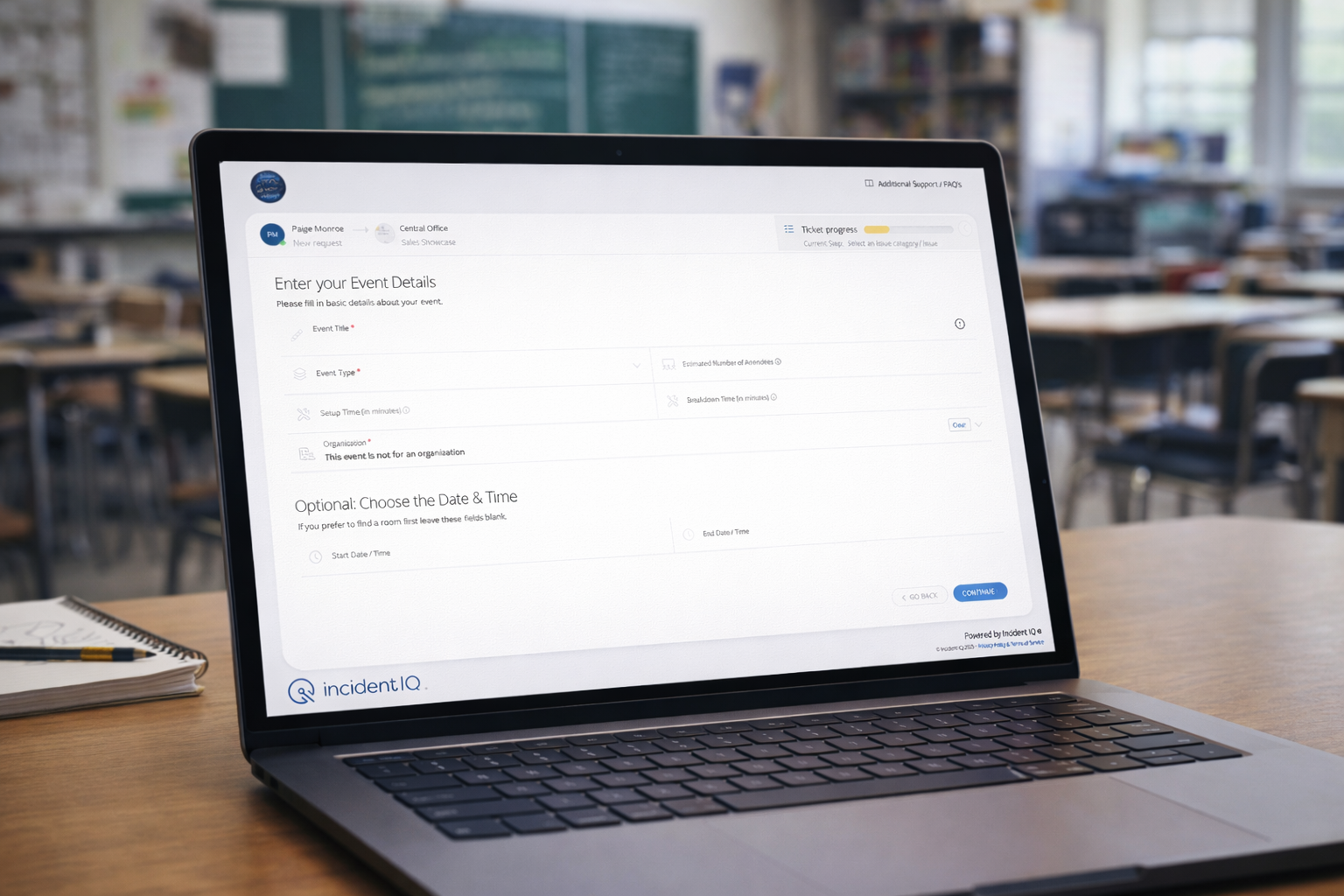
iIQ Events Management Product

Designing an event management product for Incident IQ

ROLE
Lead UX Designer
TIMELINE
2 months (2023)
TOOLS
Figma, Miro
Project hero mockup

Overview

The School Event Management product is part of the Incident IQ K-12 platform, a suite of tools built to simplify operational workflows for school districts across all 50 U.S. states. This module enables school staff to plan, reserve, approve, and coordinate campus events more efficiently by centralizing event requests, reservation details, approvals, and preparation tasks in one hub.

As the sole UX lead, I owned design from discovery through delivery for this initiative while working closely with the PM, dev lead, and engineers.

The Problem

School administrators and staff spend significant time juggling disparate tools — calendars, spreadsheets, email threads — to coordinate campus events. This often leads to:

  • Double bookings and schedule conflicts
  • Lack of transparency around space availability
  • Unclear approval status
  • Operational friction during preparation and setup

The event planning workflow needed to be self-serve, efficient, accurate, and tailored to K-12 needs.

The Solution

Since launch, the product delivers:

  • A centralized event scheduling experience designed specifically for K-12 workflows.
  • Reduction in scheduling conflicts reported by early users.
  • Streamlined approval and logistics coordination for campus events.

District staff now have visibility and control of event reservations, approvals, and event logistics in a single workflow.

Results & Impact

800+ events coordinated weekly

500+ staff hours saved annually

Improved workflows from billing to clean up

12k events organized per year

Contraints & Consideration

  • Time: Only two months to take the feature from concept to launch
  • Research: Limited direct research due to timeline and user access — only two school stakeholders interviewed and small amounts of existing feedback available
  • Scope: The solution needed to integrate smoothly with the existing Incident IQ platform without destabilizing shared UI patterns

These constraints informed prioritization and scope decisions throughout the project.

Research & Discovery

Given the tight deadline, research leaned on a mix of:

  • Existing user feedback collected by internal teams prior to this project
  • Two targeted interviews with school administrators about how they currently schedule and manage events
  • Product analytics and competitive investigation around reservation tools and calendar features

Key Insights

Key themes surfaced:

  • Users need a single source of truth for event scheduling
  • Critical information (capacity, space details, approvals) must be visible upfront
  • Reducing manual coordination (phone calls, emails) is a priority

Design & Exploration

Based on insights, I developed user flows illustrating current vs future event planning processes, wireframes for request forms, availability calendars, and the admin approval dashboard, and interactive prototypes for key screens.

The design focused on form fields tailored to K-12 requirements (e.g., room size, capacity, availability), real-time conflict warnings to prevent double bookings, and visual and interaction patterns aligned with the broader Incident IQ platform components.

Visual language balanced density and whitespace to avoid overwhelming school staff with information, while still providing context for decision-making.

Development Collaboration

Working hand-in-hand with our PM and dev team we:

  • Reviewed prototypes together to ensure feasibility given the two-month constraint
  • Prioritized MVP features for launch (reservation request, availability view, approvals)
  • Scoped later enhancements for post-launch iterations

Cross-team alignment was maintained through regular sprint syncs and design walkthroughs.

Validation & Exploration

The product launched on schedule. Due to timeline limits, validation focused on:

  • Feedback from early adopters within a pilot district
  • Monitoring usage patterns in the reservation interface
  • Collecting qualitative feedback from admins on clarity and usability

Because the tool is publicly listed as part of Incident IQ’s platform, and districts schedule demos and implementations in real-use environments, the core UX goals were aligned with reducing manual event coordination and increasing visibility across school operations.

Reflection

Working within tight time and research constraints sharpened my focus on:

  • Prioritizing core user needs over “nice-to-have” features
  • Making design decisions that align with existing platform patterns
  • Maintaining clarity in user flows where real user feedback is limited


If given more time, I would conduct broader usability testing across multiple school districts and iterate based on patterns of use across different event types (sports, assemblies, parent nights, etc.).

Thanks for reading!

View more projects