Aardvark Accessibility

Exploring how accessibility education can be made more approachable, practical, and human

ROLE
Team Lead & UX/UI Designer
TIMELINE
1 academic semester(2022)
TOOLS
Figma, Goal-Directed Design, usability interviews, Miro
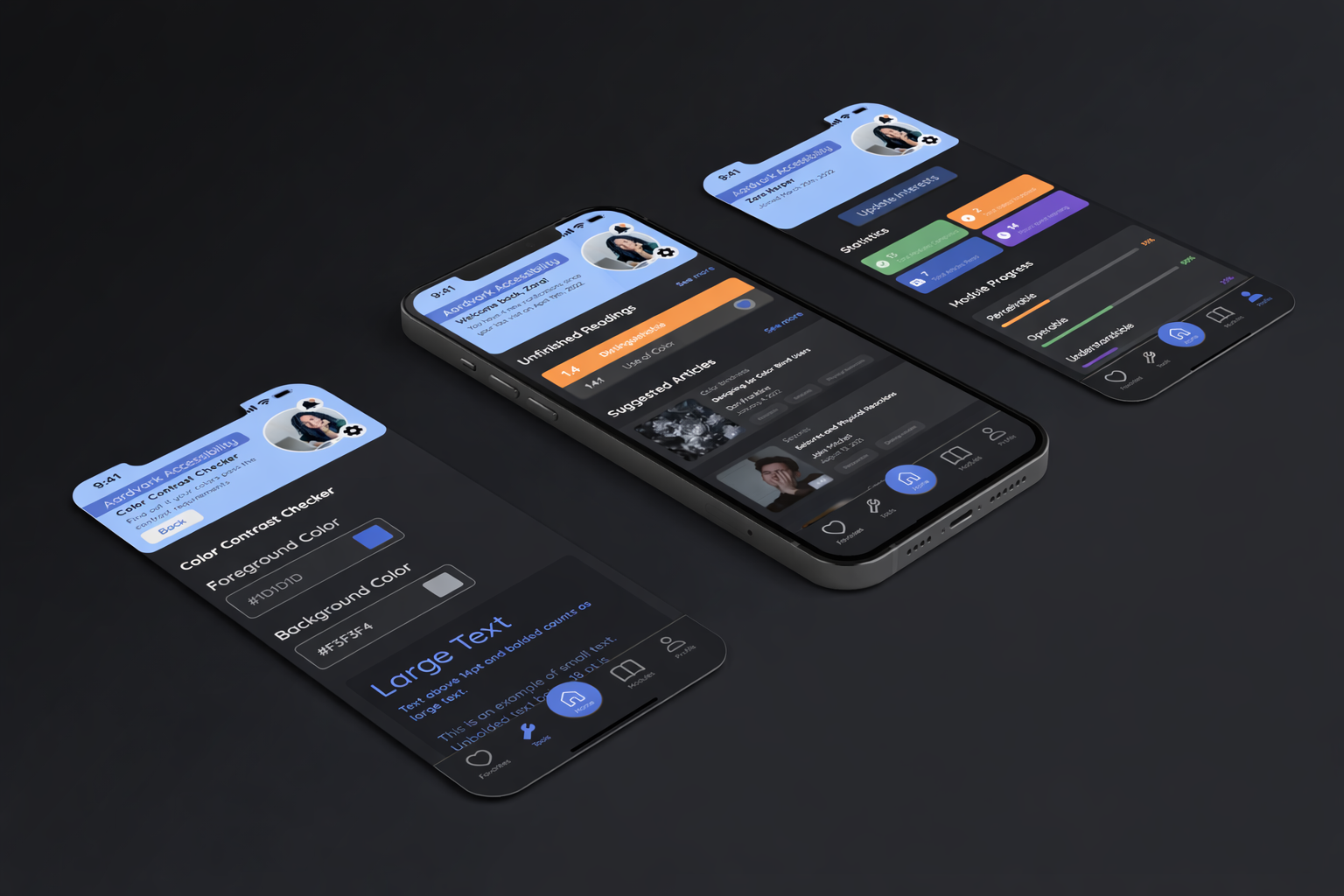
Aardvark Accessibility app mockup

Overview

Aardvark Accessibility was a mobile learning app concept designed to make accessibility education more approachable for designers and developers. The goal was to reduce the intimidation and friction often associated with learning accessibility by presenting content in a modular, flexible, and user-driven format.

The project was completed as part of a senior capstone course and explored how accessibility principles could be taught in a way that fits naturally into users’ workflows and learning styles.

The Problem

Many accessibility resources are:

  • Overly text-heavy
  • Difficult to navigate
  • Designed more for compliance than learning
  • Intimidating for designers new to accessibility

This creates a barrier to adoption and discourages designers from engaging with accessibility early in the design process.
The Solution

Aardvark Accessibility proposed a learning experience that:

  • Breaks accessibility concepts into digestible modules
  • Supports different learning styles (reading, watching, exploring)
  • Allows users to learn at their own pace
  • Emphasizes practical understanding over compliance checklists

Accessibility was treated as a design mindset, not just a technical requirement.

Results & Impact

Demonstrated how accessibility education can be more engaging and less overwhelming

Produced a cohesive, end-to-end learning experience prototype

Reinforced accessibility best practices through interaction, not just content

Provided a strong foundation for future iteration or expansion

Contraints & Consideration

  • Academic timeline limited the scope and depth of validation
  • No direct stakeholder or subject-matter expert access
  • Usability testing limited to a small number of participants
  • Design decisions needed to balance learning depth with simplicity

These constraints informed a focused, concept-driven approach rather than a fully validated product.

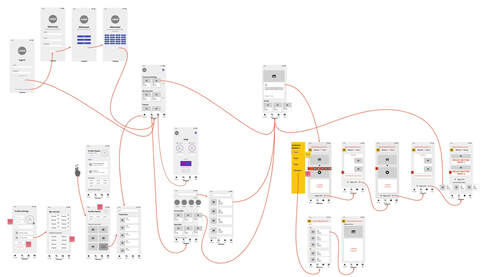
wireframes of Aardvark Accessibility app

Research & Discovery

Research combined:

  • Literature review of accessibility principles and learning design
  • Competitive analysis of learning and educational apps
  • User interviews with designers and students interested in accessibility

Insights from this phase highlighted the need for clarity, modularity, and flexibility in how accessibility content is presented.

Key Insights

  • Accessibility learning resources are often overwhelming for beginners
  • Modular content reduces intimidation and improves retention
  • Users want to apply accessibility concepts immediately, not just read about them
  • Designing for accessibility benefits all users, not just edge cases

Design & Exploration

Design exploration focused on:

  • Structuring content into clear, navigable modules
  • Creating intuitive navigation and search patterns
  • Designing tools that support exploration and reference
  • Maintaining readability and clarity across screens

Low-fidelity wireframes and prototypes were iterated to validate structure and flow before moving into higher fidelity design.

Design mockup

Development Collaboration

This was a design-only academic project with no development handoff. However, designs were created with feasibility in mind and aligned with a parallel desktop experience to ensure consistency across platforms.

Validation & Exploration

Validation included:

  • Usability testing with two participants from initial interviews
  • Think-aloud testing to evaluate navigation and comprehension
  • Iterative refinement based on observed friction points

Testing revealed opportunities to improve spacing, hierarchy, and discoverability, which were addressed in the final prototype.

Reflection

This project deepened my understanding of accessibility as a foundational design principle rather than a checklist. It reinforced the importance of designing learning experiences that respect users’ time, cognitive load, and motivation.

If revisited, I would expand usability testing with a broader range of accessibility experience levels and incorporate subject-matter expert feedback to further refine content depth and accuracy.

Thanks for reading!

View more projects See prototype